
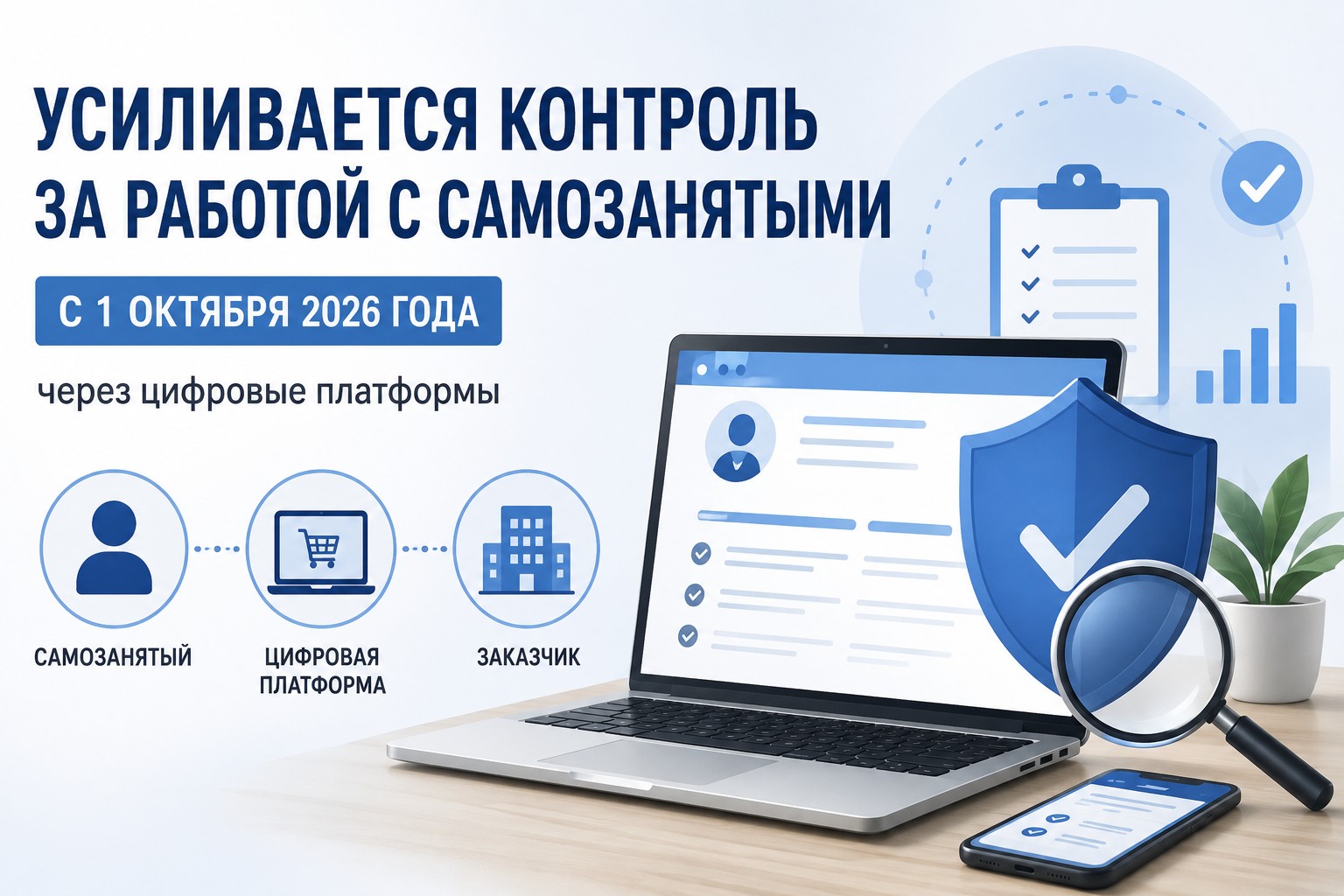
 Self-Employed and Digital Platforms: What Will Change from October 1
From October 1, 2026, digital platforms will begin applying a new control mechanism when working with self-employed individuals and individual entrepreneurs. The changes do not cancel the professional income tax regime and do not prohibit cooperation with contractors, but introduce additional measures aimed at preventing the substitution of labor relations. Let’s figure out who will be affected by the new requirements and what businesses need to consider.
From October 1, 2026, the provisions of Federal Law No. 289-FZ dated July 31, 2025 “On Certain Issues of Regulation of the Platform Economy in the Russian Federation” come into force. In furtherance of this law, the Government of the Russian Federation adopted Resolution No. 760 dated June 19, 2026, which approved the criteria upon reaching which the operator of a digital platform is obliged to temporarily restrict interaction between the customer and the contractor.
It is important to note that the new rules do not change the rules for applying the professional income tax and do not prohibit cooperation with self-employed individuals or individual entrepreneurs. Their purpose is to strengthen control over cases where civil law relations actually replace labor relations.
Who will be affected by the changes
The new requirements apply to cases where work or services are performed through digital platforms: marketplaces, service aggregators, contractor search services, freelance exchanges and other similar electronic platforms.
At the same time, the mechanism does not apply to all areas of activity. Resolution No. 760 of the Government of the Russian Federation defines a list of activities in which the risk of substitution of labor relations is recognized as the highest.
In particular, these include construction, trade, maintenance of buildings and territories, transport and warehousing, public catering, information technology, real estate transactions, advertising, education, recruitment, as well as a number of other activities.
When the platform will restrict interaction
The operator of a digital platform is obliged to temporarily restrict interaction between a specific customer and a specific contractor if two conditions are simultaneously met:
● cooperation continues for more than six months in a row;
● in each of these months, the contractor performs work or provides services to this customer for more than 60 hours.
In this case, the possibility of further interaction between this particular “customer-contractor” pair through the digital platform is limited.
At the same time, the legislation does not establish a prohibition on carrying out activities or cooperating with other customers.
Why new measures are being introduced
The main objective of the changes is to reduce cases when instead of an employment contract, contracts with self-employed individuals or individual entrepreneurs are used, although the relations actually have signs of employment.
If a contractor works primarily for one customer for a long time, is integrated into the organization’s activities, obeys the established schedule and internal rules, such relations may be recognized as labor relations with all the ensuing legal consequences.
Until now, such situations were identified primarily by tax authorities and the State Labor Inspectorate. Now an additional control mechanism is also being imposed on digital platform operators.
What is important for customers to consider
Organizations and individual entrepreneurs still have the right to attract self-employed individuals and individual entrepreneurs to perform work and provide services.
However, with long-term cooperation with one contractor through a digital platform, it is necessary to take into account the criteria established by Government Resolution No. 760.
If a contract is concluded directly, without the use of a digital platform, the automatic restriction mechanism does not apply. At the same time, this does not exclude the possibility of verification by tax authorities or the State Labor Inspectorate. If it is established that a civil law contract actually covers labor relations, additional taxes and insurance contributions, penalties, fines and other consequences provided for by law are possible.
Expert Commentary
Long-term cooperation with a self-employed person or individual entrepreneur in itself is not a violation of the law. What matters is not the duration of work, but the actual nature of the relationship between the parties.
If a contractor independently organizes his activities, does not obey the internal labor regulations of the customer, independently determines the methods of performing work, bears entrepreneurial risks and provides services to several clients, such relations, as a rule, retain a civil law nature.
If a contractor actually works as a full-time employee, performs duties on a daily basis according to a set schedule, reports to a manager and receives remuneration for the labor process, and not for a specific result, the risk of requalification of relations increases significantly.
The new requirements for digital platforms are another step by the state aimed at reducing such risks. Therefore, businesses should already conduct an audit of existing contracts with self-employed individuals and individual entrepreneurs, especially if cooperation is carried out through digital platforms and is of a long-term, regular nature.
Conclusion
Federal Law No. 289-FZ and Government Resolution No. 760 do not change the procedure for applying the special tax regime for self-employed individuals. They introduce an additional control mechanism in the platform economy.
Companies using digital platforms to find contractors are advised to assess existing contractual relationships in advance and ensure that their content corresponds to the civil law nature of cooperation. This approach will minimize the risks of restricting interaction through the platform and avoid possible claims from regulatory authorities.
On advertising rights:
We at “Auditoria” provide accounting services, tax planning and reporting preparation. We will help you adapt to changes in legislation and ensure the accuracy of financial documentation.
Trust the professionals of “Auditoria”!
Source: https://buh-a.ru/o-companii/novosti/11-novosti/381-samozanyatye-i-tsifrovye-platformy-chto-izmenitsy…
Telegram: auditoriya_buh
MAX: https://max.ru/id7716236377_biz
E-mail: auditoriya@buh-a.ru