
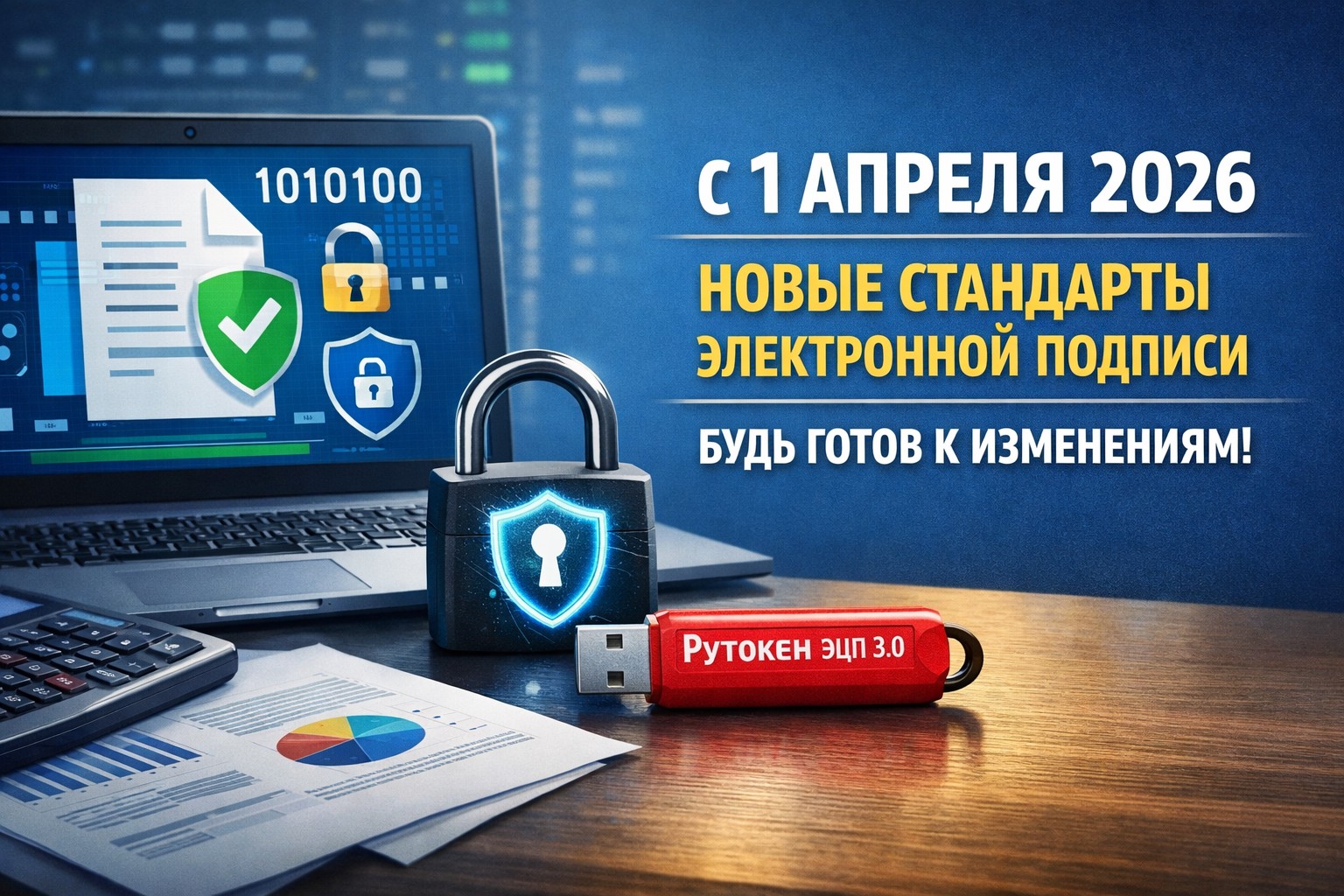
 From April 1, 2026, the Russian Federal Tax Service (FTS) is transitioning to new cryptographic standards for electronic interaction with taxpayers.
This does not mean that “all signatures will stop working”, but it does mean something else:
if a workstation does not meet the new requirements, failures may occur when sending and receiving documents.
What is an electronic signature (ES)
An electronic signature (often referred to as an ES or digital signature) is a digital counterpart of a handwritten signature.
In business, it is used in the form of a qualified electronic signature (QES) for:
-
filing tax and accounting reports;
-
signing documents in EDI (electronic document interchange);
-
interacting with government agencies;
-
participating in tenders and contract work.
A signature confirms:
✔ the identity of the signatory
✔ the integrity of the document
Without it, a modern company essentially cannot function.
What exactly is changing
The Federal Tax Service is implementing new encryption standards:
-
GOST 34.12-2018
-
GOST 34.13-2018
The change concerns not the signature itself, but the encryption mechanism used during data transmission.
📌 Practical implication:
old settings and software may not support the new algorithms.
Where problems may arise in practice
If a system is not updated, the following issues can occur:
-
the document is not sent to the tax office;
-
the report is not accepted;
-
exchange via the EDI operator fails;
-
encryption or signature errors appear.
Important:
This is not a legal problem, but a technical one – however, the consequences are purely legal (missed deadlines, fines).
What needs to be checked
1. Crypto provider
The CryptoPro CSP software must support the new algorithms.
✔ Typically, version 5.0 (R3) or higher is required.
❗ For precise requirements, check with your EDI operator.
2. Electronic signature token
The token must support the new standards.
✔ Rutoken EDS 3.0 meets the requirements.
❗ Older models may not be suitable for working with the Federal Tax Service.
3. Signature certificate
Differentiate:
-
For heads / individual entrepreneurs: generally a new certificate on a new token will be required.
-
For employees: migration may be possible, but only if allowed by the key settings and the software used.
How to check readiness
The Federal Tax Service recommends using the “Workstation Setup Wizard” (Master nastroyki rabochego mesta).
It will check:
-
crypto provider version
-
driver correctness
-
token compatibility
If errors are found, they must be fixed before filing reports.
Alternative view: this is not a “crisis”, but a planned migration
It is important to understand:
the transition to new algorithms is not an emergency measure, but a planned strengthening of data protection.
For companies that have:
-
updated software,
-
modern tokens,
-
valid certificates,
this transition may pass almost unnoticed.
Conclusion
From April 1, 2026, it is not the electronic signature itself that changes, but the technical environment in which it is used.
📌 The main risk is not in the law, but in unprepared workstations.
Therefore, the task for businesses right now is simple:
check and, if necessary, update the system in advance to avoid failures at the most critical moment – when submitting reports.
If approached in advance, the transition will go smoothly. If postponed, the problem will appear when there is no time left to fix it.
Ask an expert
As an advertisement:
We at “AuditoriYa” provide accounting services, tax planning, and reporting preparation. We will help you adapt to legislative changes and ensure the accuracy of your financial documentation.
Trust the professionals at “AuditoriYa”!
Telegram: auditoriya_buh
MAX: https://max.ru/id7716236377_biz
E‑mail: auditoriya@buh-a.ru