
On April 28, 2025, the conference “Formation of Russian and Moscow Cultural Identity” was held in Moscow with the support of. The event was dedicated to issues of cultural identity in a multipolar world (the project is being implemented with the support of Grants from the Mayor of Moscow for socially oriented NGOs of the Committee for Public Relations and Youth Policy of the City of Moscow).
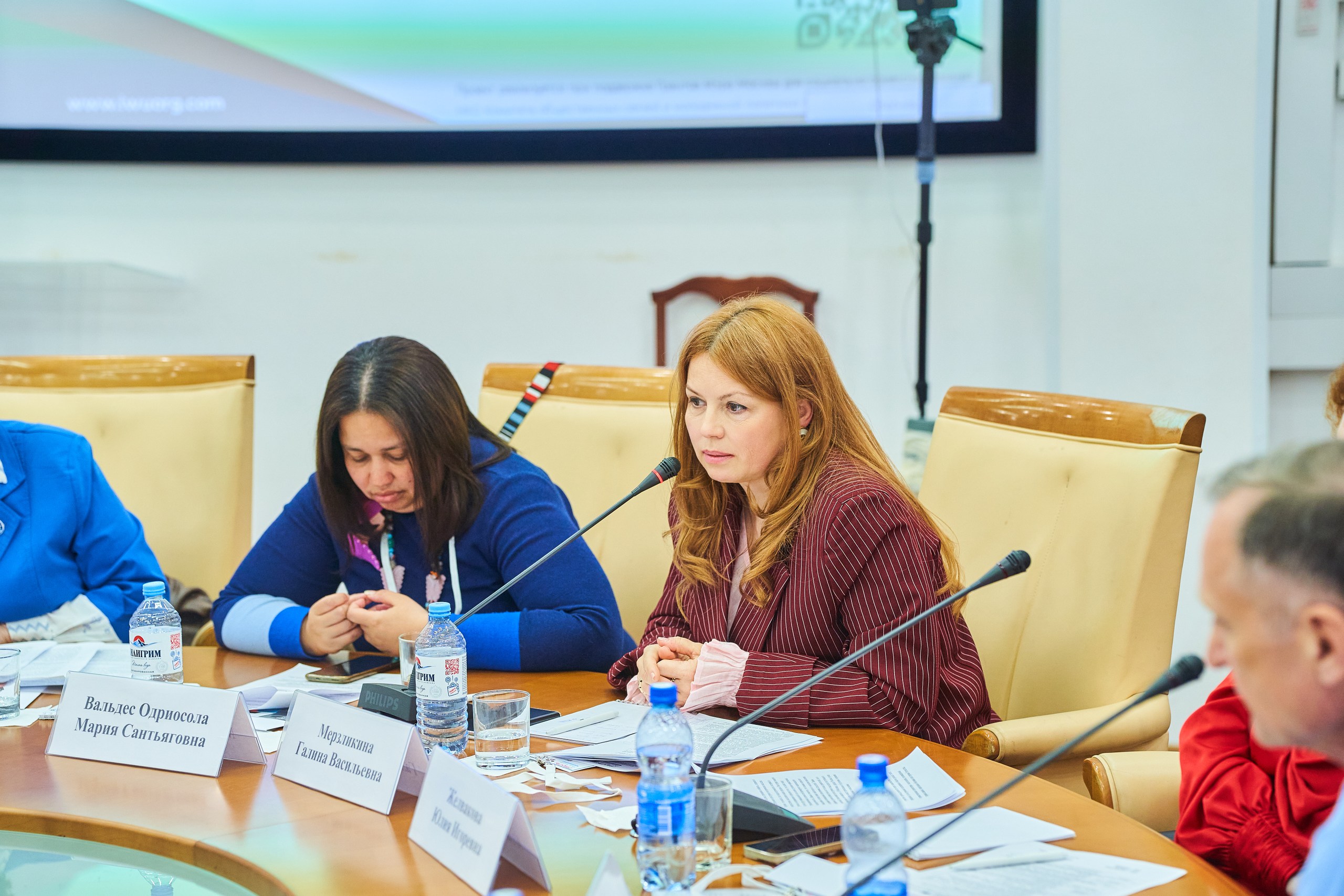
Participated in the Conference as an expert speaker. Galina Vasilyevna Merzlikina, art critic, curator, journalist, expert in the field of contemporary art.
Galina Vasilyevna highlighted the topic: “The Russian language as the basis of unity and support for linguistic diversity.”
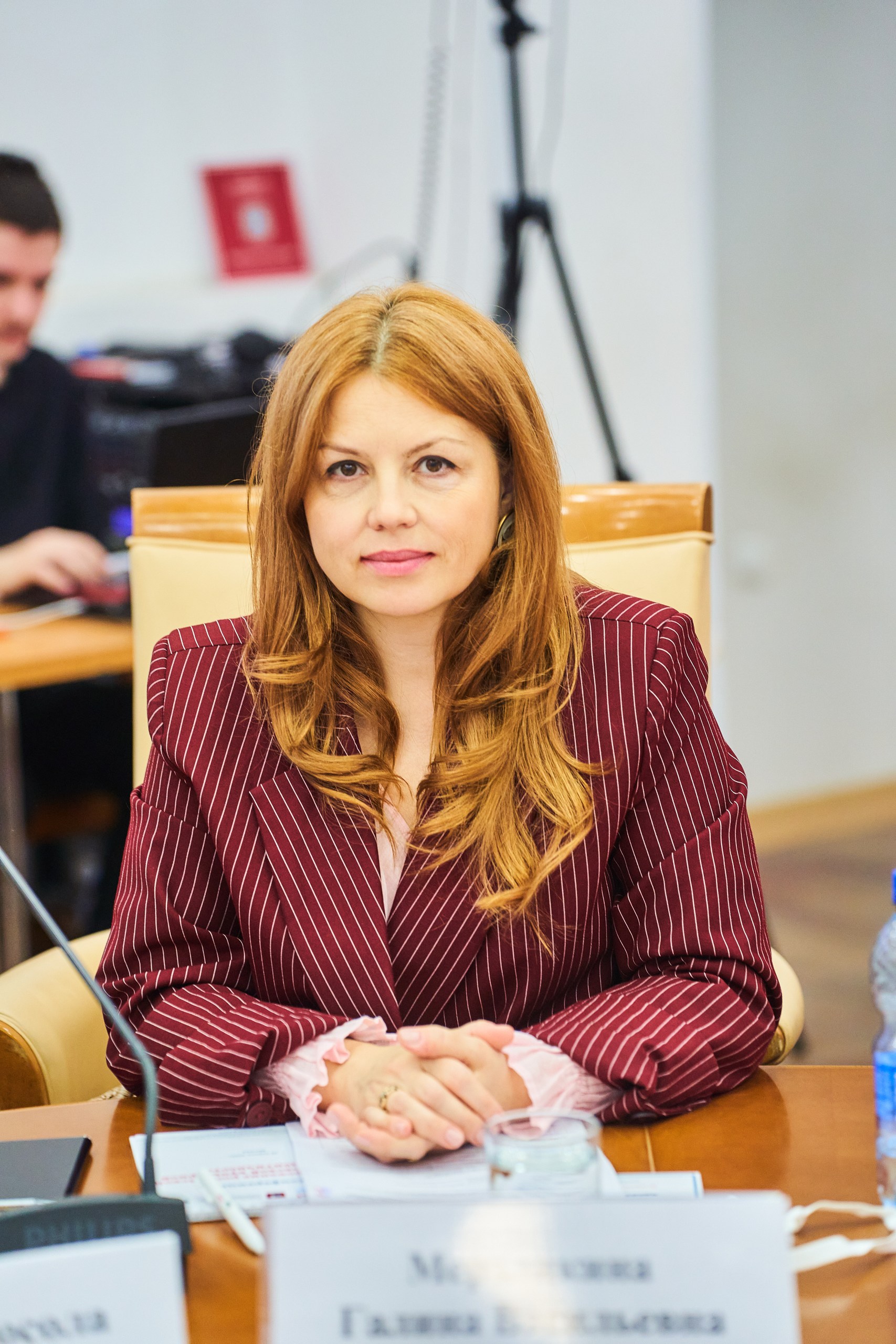
Language is the main means of communication.As of 2024, there are 7164 languages in the world.The development of society, science, technology, and art is impossible without language. It serves to express a thought.
Russian is the official language of the Russian Federation, and it also has official status (along with other languages) in Abkhazia, Belarus, Kazakhstan, Kyrgyzstan, and other countries.
Russian is one of the six working languages of the United Nations and UNESCO, and is also used as a working language in other international organizations. The Russian language serves as a means of interethnic communication in the CIS and other countries that were part of the USSR.
By learning the language, we study the culture and history of the country. Russian Russian appeared for the first time in its modern form in the 19th century, during the era of Alexander Sergeyevich Pushkin, who is the founder of the modern spoken Russian language.
His work reflects the spirit of the times, national ideals and aspirations of the people. Pushkin introduced themes relevant to Russian society into literature, such as freedom, love of the motherland, and human suffering. Due to this, his works became accessible to a wide audience and contributed to the formation of national identity.
The name of Alexander Sergeevich Pushkin has become a symbol of Russian national culture. This is confirmed on the geographical and cultural map of Russia — in the names of streets, squares, gardens, squares and parks, libraries, museums, theaters, schools, lyceums and universities. In the first half of the 20th century, Russian emigration united around the name of Pushkin. Russian Russian Culture Day was widely celebrated annually throughout the world in 1925 by the board of the Union of Russian Academic Organizations Abroad, timed to coincide with Pushkin’s birthday. The anniversary celebrations united the emigration, outlining its mission — to protect and protect Russian culture.
To date, there are more than 200 monuments to Pushkin located in various countries. Here are some of them:Belarus (Minsk: The monument was erected in 1955 on Yakub Kolas Square), Kazakhstan (Almaty: The monument was erected in 1997 in the Central Park of Culture and Recreation), France (Paris: The bust of Pushkin is located in the Monceau Garden. There is also a monument on the street named after him), Germany (Berlin: Bust of Alexander Sergeevich installed in Tiergarten Park), USA (New York: There is a bust of Pushkin in Central Park, installed in 1999), Italy (Rome: Bust installed in Villa Borghese garden), Armenia (Yerevan: The monument was opened in 1945 and is located in the city center), China (Beijing Bust of Alexander Sergeevich is installed in one of the city’s parks), Egypt (Cairo: The monument is installed in a park in the city center), etc.
Moscow, as the birthplace of Alexander Sergeevich Pushkin, preserves many places associated with his life and work.
The house on Arbatskaya Square (house number 53), in which Pushkin lived from 1831 to 1837, is an important monument. Here he wrote many of his famous works, including Eugene Onegin. The interiors of that era have been preserved inside the house, as well as guided tours dedicated to the poet’s life and work.
Pushkin Square was named after the poet in 1937 and is one of the central places of Moscow. There is a monument to Pushkin by sculptor Mikhail Mikeshin on the square. This place has become a symbol of the memory of the great Russian writer and is often used for cultural events and celebrations.
The Hermitage Garden was founded in the 18th century and has become a popular place for Muscovites and guests of the capital to stroll. Pushkin often walked here, which inspired him to create. The garden retains its historical atmosphere and is still a favorite vacation spot.
Moscow University (Lomonosov)Pushkin studied here from 1811 to 1817. The university played an important role in shaping his literary talent and worldview.
Church of the Ascension of the Lord at Nikitsky Gate. On February 18, 1831, Natalia Goncharova married an official of the Board of Foreign Affairs, Alexander Pushkin, in the unfinished church, in the chapel of St. Nicholas the Wonderworker.
St. Nicholas Church on Three Mountains. Pushkin’s mother, Nadezhda Osipovna Goncharova, was buried here. The church has become an important place for the poet’s family and symbolizes the connection with his roots.
These places not only preserve the memory of Pushkin, but also allow modern generations to better understand his life and work.
Russian Russian Language Day and Culture Day will be celebrated in the Alexander Solzhenitsyn House of Russian Abroad in 2025 by the Center for International and Cultural and Business Cooperation “Culture for Life”. On June 6, 2025, the exhibition “Around Pushkin” will open here and an international conference will be held. Today, representatives of 8 countries will take part in it, we invite them to participate.
Literature plays an important role in preserving the Russian language, as it shapes and enriches it, giving it a variety of stylistic, lexical and grammatical elements. The main aspects of literature’s influence on language preservation are the expansion of word meanings, the introduction of new words and expressions, the consolidation of linguistic norms and rules, the popularization of the literary language, and the formation of national memory.
Russian Russian speech, the great Russian word…” – these are the words of the poetess Anna Akhmatova, who have not lost their relevance for several decades. The prosperity of national culture directly depends on the attitude of the people to their history.
The great purpose of the Russian language throughout the history of the development of our state has worried the best minds.
Thinkers, scientists, poets, and writers have tried to define language precisely. Language was interpreted both as a way of doing things, and as the art of controlling people’s minds, and as an indicator of intelligence, and as a manifestation of the strength and power of human character, and as the key to all knowledge. The entire history of the spiritual life of the people is faithfully reflected in the depths of the Russian language.
Russian Russian writers besides Pushkin had a significant influence on the development of the Russian language and culture.:
Leo Tolstoy: His novels “War and Peace” and “Anna Karenina” not only enriched the Russian language with new terms and phraseological units, but also provided an in-depth analysis of the social and moral problems of their time. Tolstoy became a symbol of Russian literature outside the country.
Fyodor Dostoevsky: His works (“Crime and Punishment”, “The Brothers Karamazov”) explore complex philosophical and psychological issues. Dostoevsky’s style had a significant impact on the development of prose not only in Russia, but also abroad.
Anton Chekhov: Chekhov contributed to the development of drama and short fiction. His plays (“The Seagull”, “The Cherry Orchard”) have become classics of world theatrical literature, contributing to the spread of the Russian language through theatrical art.
Mikhail Bulgakov: Although his work became famous later during the author’s lifetime, the novel “The Master and Margarita” became one of the most widely read works of the 20th century. Bulgakov used the Russian language with extraordinary ingenuity, which contributed to its popularization.
Joseph Brodsky: Nobel Prize winner in Literature Brodsky became an important figure in Russian poetry in the second half of the 20th century. His works have been translated into many languages, which has contributed to the spread of the Russian language outside of Russia.
Russian Russian was learned by foreign celebrities in order to gain a deeper understanding of Russian literature and culture. Russian Russian actor and director John Malkovich studied Russian in order to better understand the works of Russian writers such as Fyodor Dostoevsky and Anton Chekhov. Russian Russian theater productions were also performed by him, and the famous actress Meryl Streep studied Russian for a role in the film Kramer vs. Kramer (1979), where she had to say several phrases in Russian. Russian Russian literature and culture were also shown by her, and Australian actress Cate Blanchett studied Russian for a role in the play “The Seagull” based on the play by Anton Chekhov. She noted that her knowledge of the language helped her to better understand the characters and their motivation, and American actor Tom Hanks also showed interest in the Russian language and culture. In an interview, he mentioned his desire to read Dostoevsky’s works in the original.
Russian Russian language is the core of the Russian world. A nation grows up and grows stronger on it. A person, his active citizenship, his tastes, preferences, and habits are shaped by his native language. Language allows a person to realize himself as a person, to feel his belonging to his native country, to learn the laws of human interaction. In Russia, the education of a person and a citizen by the word has always been unobtrusive and penetrating throughout his life. Despite any trials of life, it is important for a Russian person to keep the verbal symbols of the Motherland in his soul. They may become
Russian Russian folk tales, Russian literary classics, mother’s lullaby, the first Russian books for the youngest, drinking songs that unite people in sorrow and joy, greeting the first teacher, a parting word from a professor, support from a coach, and many others. A person and his worldview are shaped by the influence of historical, literary and cultural sources.
Russian Russian language proficiency, competent and appropriate Russian speech is necessary for the prosperity of the whole country and each of its inhabitants.
Before our eyes, language education is gradually becoming an important strategic task for the development of modern Russian society. The country’s leadership, public organizations, and professional communities of philologists are taking various measures in this direction. For example, 2007 went down in history as the Year of the Russian Language. In this regard, the Russian language was considered as a powerful social factor of interaction between different countries and peoples, an incentive for the development of cultural, legal, economic and political relations in the modern world. With the help of the Russian language, word education, and familiarization with reading, the spiritual unity of the Great Country continues.
The Russian language is a carrier of rich culture, literature and art. Cultural values, traditions and customs are transmitted through it. Russian Russian has been translated into many works of world literature, which allows people of different nationalities to get acquainted with Russian culture and art. Cultural events such as festivals and exhibitions contribute to strengthening interethnic ties.
Despite its importance, the Russian language faces a number of problems in the context of interethnic dialogue. This includes a decrease in interest in learning Russian among young people in some countries, as well as competition with other world languages such as English, Arabic or Chinese. Efforts are needed to promote the Russian language as a means of communication and cultural exchange.
In 2024, the Center, with the support of Grants from the Mayor of Moscow, conducted the project “Maria Tenisheva’s Legacy to the younger generation”, we showed the activities of the princess aimed at popularizing Russian culture. The decision on the need for events was made after participating in the Tenisheva Weeks in Paris.
Every language is a whole world. The language is not only a subject for study, but the living soul of the people, its joy, pain, memory, treasure. He should inspire each of us with fervent love, appreciation, and reverent attitude. The language of every nation, even the smallest, is a whole world full of charm and magic.…
I would like to take this opportunity to invite everyone to the events of the Culture for Life Center for International, Cultural and Business Cooperation. One of the closest ones is:
A series of events dedicated to the 100th anniversary of People’s Artist of the USSR Lyudmila Ivanovna Kasatkina, the project is supported by Grants from the Mayor of Moscow and will be held in the most iconic locations related to cinema and theater.: Strastnoy Boulevard, Mosfilm, GITIS, Russian Army Theater, Central Actor’s House.
The project “Around Pushkin” at the Solzhenitsyn House of Russian Abroad.
The full list of programs is on our website.: https://culture4life.com/
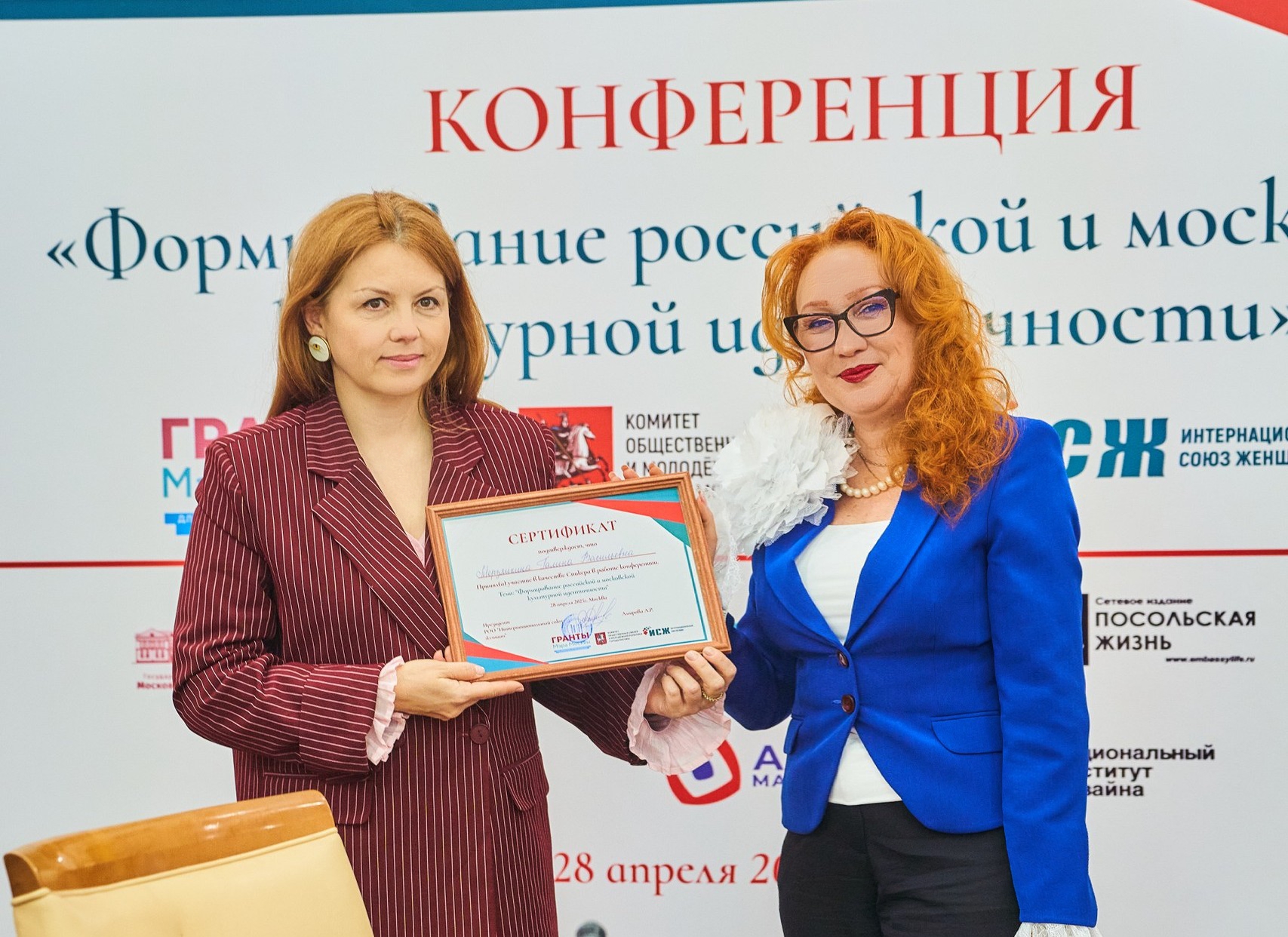
Full recording of the conference: “Formation of Russian and Moscow cultural identity” .
Follow the link for more photos. Mandatory conditions:
When using photos, YOU MUST specify the photographer’s details and the event.
https://anisimovp.ru/disk/28-04-iszh-konferentsiya-fotootchet-bk8vp7