
Since March 1, 2026, the freight forwarding services market has entered a new stage of regulation. The introduction of electronic transport documents and the launch of the “GosLog” platform are creating a centralized system for recording and controlling logistics operations.
One of the key elements has become the mandatory interaction of freight forwarders with the FSB of Russia.
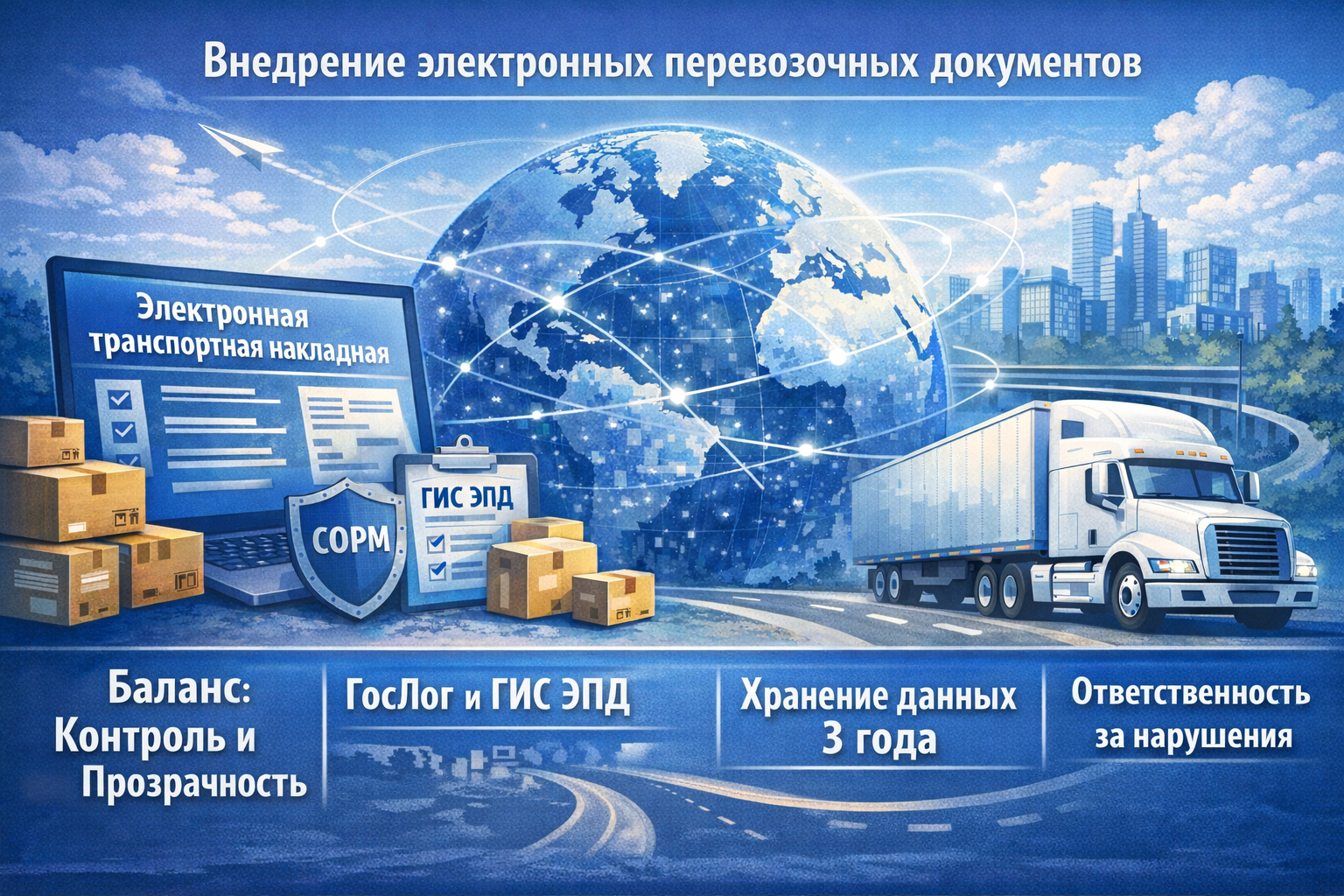 What has changed for freight forwarders
After being registered on the “GosLog” platform, the freight forwarder is obliged to:
- Submit an application to the territorial body of the FSB within 45 calendar days;
- Undergo the procedure of connecting to the technical infrastructure;
- Ensure the technical capability to interact with authorized bodies.
These requirements are established by Government Decrees No. 1317 and No. 1318 of August 29, 2025.
Key terms
For a correct understanding of the new system, it is important to note:
- ETrN – electronic transport waybill;
- GIS EPD – state information system for electronic transport documents;
- SORM – system of operational-search measures in the field of communications;
- GosLog – state digital platform for recording freight forwarding activities.
What data must be stored
Under the new requirements, freight forwarders are obliged to record:
- Client information (including personal data);
- IP addresses and other digital identifiers;
- Transport routes and geolocation;
- Cargo characteristics.
The retention period is at least 3 years from the date of execution of the freight forwarding agreement.
System architecture: what is important to understand
In its logic, the new regulatory model is somewhat reminiscent of SORM used in the telecommunications sector.
It is not about direct copying, but about similar principles:
- Creating the technical capability to access data;
- Centralized interaction infrastructure;
- Moving from selective to systematic control.
Access to information is carried out in the manner prescribed by law.
Role of GIS EPD
The central element of document flow is GIS EPD.
The system provides:
- Centralized data storage (at least 5 years);
- Verification of document correctness and electronic signatures;
- Control over the sequence of actions of participants;
- Recording of transport statuses;
- Provision of data to regulatory authorities.
Important: access of various agencies to information is carried out within their powers and through the prescribed channels.
Correcting errors in ETrN
The new procedure eliminates informal corrections:
- Before signing, the document can be edited;
- After sending – only through a corrective title.
This enhances the legal significance of electronic documents.
Transition period
- Until September 1, 2026, the use of paper documents is allowed;
- After that, the transition to electronic format becomes mandatory.
For certain categories of goods (in particular, alcoholic products), special transition periods are provided until 2027.
Liability for violations
After the transition period, the absence of electronic transport documents entails administrative sanctions:
- For drivers – up to 1,500 rubles;
- For officials – up to 20,000 rubles;
- For legal entities – up to 250,000 rubles.
Practical consequences for business
-
Additional expenses – investments in IT infrastructure, data storage, and integration with state systems will be required.
-
Increased transparency of operations – all stages of transportation are recorded and can be checked.
-
Strengthened state control – data can be used by various agencies, including the Federal Tax Service of Russia, the Ministry of Internal Affairs of Russia, and Rostransnadzor, within their competence.
-
Increased personal data requirements – organizations must ensure compliance with data protection and data localization legislation.
Balance: not only control
It is important to note that the implementation of the system is aimed not only at strengthening state control.
Expected effects include:
- Reduction in the share of “gray” (informal) transportation;
- Increased market transparency;
- Simplified interaction with regulatory authorities;
- Reduction in the amount of paper documents;
- Reduction in the number of disputes between transport participants.
Conclusion
The transition to electronic transport documents is a systemic change in the industry.
For businesses, this means:
- The need to adapt processes,
- Increased requirements for accounting and IT,
- An increased role of legal and accounting functions.
At the same time, the new model creates a more transparent and formalized environment in which the key factor of stability becomes not flexibility, but compliance with established rules.
Ask an expert
Advertisement:
We at “AuditorIya” provide accounting services, tax planning and reporting preparation. We will help you adapt to changes in legislation and ensure the accuracy of financial documentation.
Trust the professionals at “AuditorIya”!
Source:
Telegram: auditoriya_buh
MAX: https://max.ru/id7716236377_biz
E-mail: auditoriya@buh-a.ru
The views expressed in this information product are those of the author(s) and do not necessarily reflect the position of the editorial board of the online publication “Embassy Life”.