
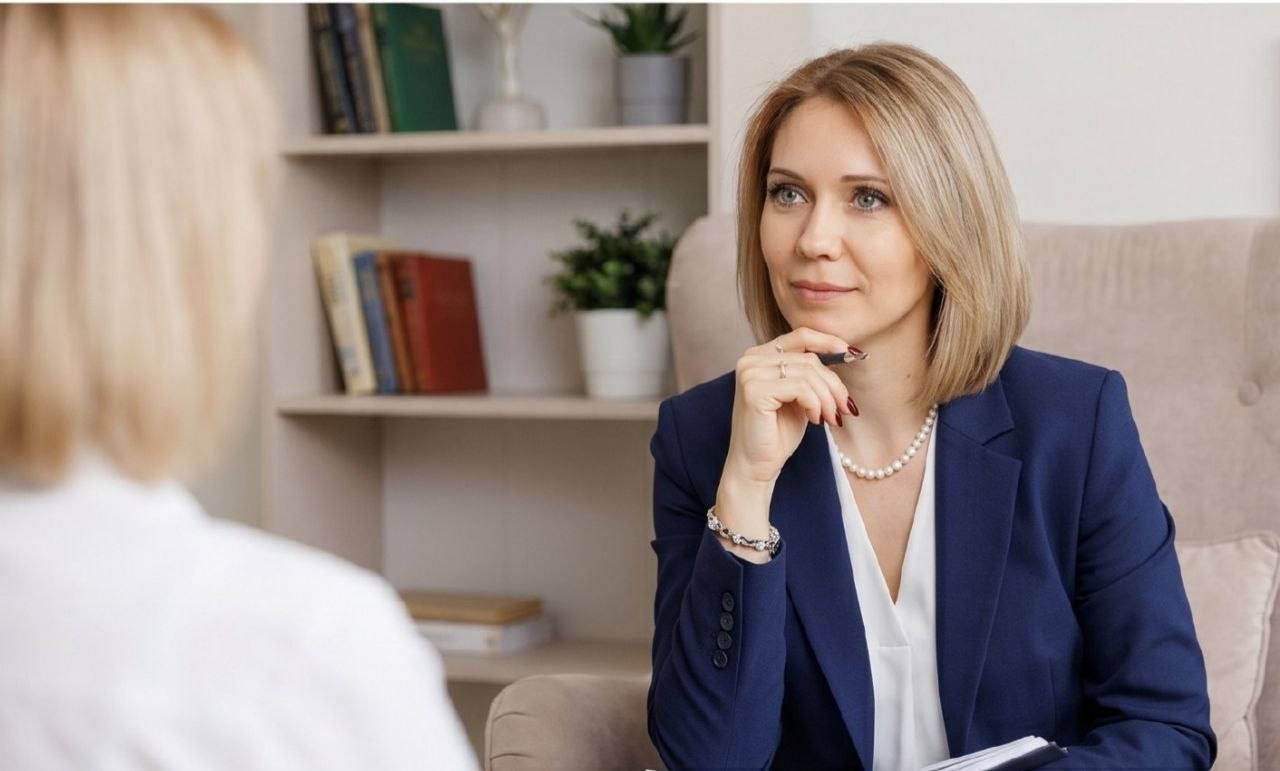
A successful woman comes to see me at a reception. Behind her — a brilliant career, completed projects, the respect of colleagues. But in her eyes — tears. She held it together through every deadline, withstood any negotiation. And that morning she snapped at her son over some scattered socks. “I’m a bad mother,” she says.
And I hear this from my clients again and again.
We live in an era of high parental standards. Social media, blogs, and expert channels daily show us the portrait of the ideal mother: always calm, always smiling, always knowing the right answer.
She bakes healthy desserts, builds trusting relationships with her child, keeps her voice steady, and still makes it to yoga class. This image is beautiful, but it is far from real life.
And the higher we raise the bar, the harder the fall.
Guilt becomes a constant companion of the modern woman, and it poisons not only her but also, oddly enough, her relationships with her children.
Winnicott’s Wisdom: Permission to Live Without Perfection
The British pediatrician and psychoanalyst Donald Winnicott, who devoted thousands of hours to working with mothers and infants, introduced the concept of the “good enough mother” in the mid-twentieth century.
He argued that a child needs a living mother, not a flawless one. One who makes mistakes and notices them. One who responds instantly to every need but sometimes takes a pause.
According to Winnicott, it is precisely the moments when a mother reacts with delay or makes a mistake that give the child invaluable experience: the world is not arranged the way he wants, and this can be survived. That is how resilience is born.
The “perfect” mother is a dangerous figure: she deprives the child of an encounter with disappointment, hinders his independence, and creates anxious attachment.
Winnicott wrote that a mother is good enough precisely to the extent that she meets basic needs, while leaving space for the child to encounter reality. Today we can put it more simply: a child needs a real mother, not a glossy picture.
The Price of Perfectionism: What Happens to Us and Our Children
Modern research only confirms Winnicott’s observations. In 2025, an international survey across 14 countries showed that 85% of mothers experience guilt at least once a week, and 45% — daily. At the same time, women who orient themselves toward the “ideal” image demonstrate 30–40% higher rates of anxiety and depression than those who treat themselves with kindness.
According to a Finnish study (University of Jyväskylä, 2024), it is the perceived pressure of social standards, rather than the actual amount of caregiving, that correlates most strongly with maternal exhaustion.
We burn out from feeling that we are doing too little, not from the actual volume of tasks.
And this affects children.
Research shows that maternal anxiety and chronic guilt are passed on to the child. Children of mothers striving for perfection more often face anxiety — they sense their mother’s fear of making a mistake. And they learn: a mistake is a catastrophe. And therefore they lose the ability to try new things, to take risks, to be spontaneous.
Social Media: A Mirror of Fear
I call the phenomenon of “hunting for the ideal” on social media “diagnosis by picture.”
We scroll through another mother’s photoshopped breakfast, read about her “easy” childbirth, see her child who reads at age two — and compare ourselves.
This comparison always points in one direction: upward, to where things are supposedly “better.” We rarely look at those who have it harder. We always look at those who have it “more perfect.”
Neurobiologically, at that moment, the brain area responsible for social pain is activated. We experience the comparison as a real blow.
And if we do this daily for 15–20 minutes, our nervous system is in constant tension.
A gentle solution: introduce a “digital pause for comparison” — follow those who show difficulties, breakdowns, and ordinary days too. Unfollow channels that make you want to become better at the expense of feeling worthless. And each time ask yourself the main question: “What does MY child need right now?” rather than “What does the ideal mother from my phone do?”
The Practice of the “Good Enough Mother”: How to Become an Ally, Not a Judge
What does a “good enough” mother look like in 2026?
She takes off the mask of perfection.
She:
- Acknowledges her mistakes and returns with an apology. If you snapped, come over and say: “I yelled because I was tired. My tiredness is my responsibility. It has nothing to do with you. I love you.” This gives the child a powerful experience: adults make mistakes too, and that is normal. They can admit it and restore connection.
- Speaks her needs out loud. “I will drink tea for 15 minutes in silence, and then we will draw together.” When a mother respects her boundaries, the child learns to respect others’. Children whose mothers live fully grow up more empathetic and independent.
- Allows herself to be busy and absent for short periods. Winnicott called this “maternal absence in small doses.” Pauses when mother works, reads, or talks on the phone develop the child’s imagination and patience. It is important for him to know that mother will return when he truly calls.
- Lets go of the race for early development. Your child is valuable in himself, not for the number of skills. Early development without regard for his living interest is often our anxiety, not his need. Children grow up happy and capable when they are allowed to be children.
How We Help at the IWU: Support Instead of Guilt
At the ROO “International Women’s Union,” we have long observed this picture: women come to us with brilliant résumés and a heavy burden of guilt on their shoulders. We realized: guilt and burnout flourish in silence and isolation. They need light — living conversation, open discussion, professional perspective, and a warm community.
That is precisely why, on September 23, 2026, in Moscow, our Department of Social Design and Crisis Intervention is holding the I All-Russian Conference “Modern Motherhood: Challenges, Resources, Solutions.”
Why is this important right now?
The family always remains the foundation of personality, but today it faces challenges we could not have imagined ten years ago.
A modern mother manages to build a career, take care of herself, raise children (including those with special needs), and remain a pillar of support for the entire family.
How does one maintain balance?
How does one cope with the workload when there are so many expectations around?
How can we build a system where there is room for mom, dad, and children — each in their own way?
Particular attention must be paid to single motherhood. Women are left alone with children, juggling the roles of breadwinner, educator, and psychologist.
How can we help such mothers? How can we create a real, working support system rather than just talking about it?
These questions are especially acute in the context of state policy aimed at strengthening the institution of the family, supporting large families, and preserving traditional values.
We invite to the conference certified psychologists, coaches, mentors, social workers, educators, physicians, NGO representatives, and all helping professionals — practitioners with proven experience who are genuinely committed to making a difference for every family and the nation as a whole.
What awaits participants?
The conference will bring together 10 speakers — 7–10 minute presentations and live discussion where every voice will be heard.
The program includes:
- an honest analysis of the challenges of modern motherhood, family, and single motherhood;
- best practices: working with single mothers, with complete families, with children with special needs, and involving fathers in upbringing;
- an open mic and open discussion — a space where ideas are born;
- the formation of a working group of our Department in the direction of “Family, Motherhood and Childhood.”
The official information partner of the conference is the online publication “Embassy Life,” which unites an audience of over 550,000 people.
It is important to us that this conversation goes beyond the professional circle and becomes part of a broad public discussion.
The most valuable thing I see in this project is the opportunity to stop being alone in our questions.
When we gather together, guilt melts away. In its place come clarity, support, and concrete tools. We create a space where every mother can say: “I want to be a good mother, and I have the right to help.” And to receive that help — from professionals and from women just like her.
Dear women, colleagues, mothers.
On behalf of the IWU and personally, I appeal to you: take off the burden of perfection. Your child chose you alive — tired, laughing, sometimes angry, sometimes crying. Allow yourself to be “good enough.” It is to this mother — the one who makes mistakes and continues to love — that children come for advice years later. They come with trust, because they saw: she was real.
That is the highest art of parenting.
#ModernMotherhood #GoodEnoughMother #Winnicott #IWU #Conference2026 #SupportForMothers #NoToMomGuilt #FamilyValues #Moscow